I’ve been thinking about the results of That Poll on how our creativity and our loved ones interact. If you’re a numbers fiend, here are the poll results in order of how many votes each choice received:
Being part of a supportive writing community: 25% of the choices that people made included this choice
Being a writer is a lonely life; at the end of the day, your support system doesn’t do the writing – you do: 18%
My dear ones are supportive of my writing, so it’s never been an issue: 14%
Other: 13% (which included everything from meeting your friendly neighborhood librarian – a great idea! – to waiting to show your work in real life print )
Hermitting: 11%
Creating a supportive community: 10%
Putting a firewall between my writing life and my other life : 7%
Therapy : 2%
I found a lot to be heartened about here : for example, that many of us have supportive people to hang out with when our daily support system isn’t quite working for us.
I’m also impressed at the complexities we encompass: we can simultaneously love people and understand that they can’t be everything to us all the time; we can be solitary in creation but we nurture that process through interactions.
In short, we’re good at casting a wide net to help ourselves create, whether that net grabs us a “room of one’s own” or a support system to be part of.
One thing I didn’t poll on is the professional support that creative people sometimes need/choose to have: editors, agents, publishers, typists, translators, transcribers, teachers, writing groups. I’m going to let Andrea introduce her wonderful editor, but I wanted to mention the editing company because Write Helper is running the Burning The Midnight Oil Poetry Contest, a rare contest that provides cash prizes for the winners, plus a free critique for all entrants. So if you’re a poet casting your net for new places to place your work, the contest is open now through next week (Oct 31st) – throw your net out onto the waters, see what comes back to you !
[ina’s note: This was supposed to be Monday’s post, but we had a time dependent notification to put up yesterday. So, we’re having coffee a day late. Y’all don’t mind late coffee, I hope? We can even make it decaf if you like 🙂 ]
The strange part is that we tend to tell everyone how those who surround us respond instead of describing what we do. Heartbreaking descriptions pour out, like this from Judith on She Writes: “I was surprised at how many of my friends were not supportive when my novel was optioned for the big screen. My husband said it was because they were jealous. I didn’t want to believe him. I thought good friends were happy for each other when they achieved some success. My husband’s response was, ‘these were not your good friends.’”
And Dana writes: “Happy to vote on that question. I’ve had an in-law that wasn’t supportive at all, but then she was never supportive about anything and hence the word ‘had.’ My immediate family, very supportive. This community was incredibly helpful (without really knowing it) during some of the down times.”
Hello, dear readers. A knotty problem today, waiting for your thoughts.
A blog I follow has a post about a problem that many writers I know (and many more that I’ve only read about in biographies) seem to run into (in Western cultures particularly – some day we’ll have to talk about why there’s so much variation in attitude between cultures). The author describes the problem like this:
You see, friends, my immediate family simply doesn’t understand me. They don’t know why I like to do what I do. They don’t have any interest in things that I love. They just barely fall short of making fun of me for doing what I am so passionate about..It’s all about being true to oneself, isn’t it? Rarely an easy thing to do, but made even more difficult when those immediately around you will not lovingly accept it.
The trope of the Misunderstood Writer has a long and venerable history. But behind the trope is a truth that many writers live and struggle with every day. It’s a little annoying when you’re confronted by a relative stranger at a party or a school meeting who comes out with: “You’re a writer. How do you pay the bills?” or “I don’t remember hearing your name – are you any good?” But it’s just plain hardwhen this vibe comes from someone you care about, or love and trust, or someone to whom you’ve devoted your own life.
I want to dispel a potential misunderstanding here: the author of the blog, Cooper Robbins*, is not a whiny wanna-be (“If I only had a supportive family, I’d be a best-seller, but no, I’m so beat by the end of the day I’d rather watch re-runs”); this is an author whose creative life includes a novel, a screenplay, and a fair amount of “&c,” on top of maintaining a home and taking care of young ones. Her post (and this post) aren’t about people who want to be writers but don’t write…this is about how we as writers keep writing in the face of resistance from those whose opinions we most value.
Camouflage, demonstrated by the Graceful Kelp Crab
Robbins does this in part by developing and participating in supportive writing communities – in a way, that’s what her blog is about. Some people (and I include myself here) have a sort of damn-the-torpedoes approach, which generally involves shutting certain people out of the creative part of one’s life. Other people hermit (to hermit: to isolate one’s self, creating a shell, and then decorating it with camouflaging materials, such as PTA meetings or banker’s three-piece suits, as needed).
So here’s my question. What do you do? What advice would you give to Cooper Robbins about how to cope with being surrounded by people who are either baffled or skeptics? NOTE: The poll should let you vote for as many choices as you want – if it doesn’t let you, tell me and I’ll go give it a strong talking to 🙂 [IOB: ina]
*unsurprisingly, this is a nom de plume – sometimes everyone needs a place to vent. I happen to have a venting blog too, and no, I don’t link it to my name and, no, I haven’t and won’t link it to this blog. Which probably says something, don’t you think?
I just finished readingTed Kooser‘s The Poetry Home Repair Manual.He’s one of my favorite poets (and not just because he’s from Nebraska), and every piece of advice he gives (with a couple of exceptions) is just right. And (those of you who write fiction), much of the book’s advice applies generally to creative writing.
This straight-forward instructional guide gives us insight into
This really IS a coffee grinder
how to choose and use a title
how to get rid of what Kooser calls the “warm up” (I call it scaffolding) – the stuff you needed to write to set up the poem, but that the reader doesn’t need to see (this is one example of something that’s really useful for fiction-writers)
how to keep from ruining a piece with “gush” or “sentiment”
your relationship with your readers
how to make sure you’re happy with the places that your work is published
when and how to use metaphor and simile and how to use them without jarring the reader out of the world you’re creating
the uses and limits of form
I was flattered to find out that some of this stuff I do by instinct (and amazed that there are formal ways to talk about it). I was appalled to find that a significant number of poems I’ve written that I love but that don’t work are victims of a really bad habit that, per Kooser, is something that underlies a lot of poetry that doesn’t work . And no, I’m not telling what that mistake is – it’s too embarrassing *blush*
But of course, being a “professional philosopher,” I can never leave something uncritiqued, and I’m going to point out those two places where I think he’s mistaken:
1) Kooser says that if you send something out four or five times, and it’s not accepted, there’s probably something wrong with the poem. He does qualify this by noting that you should make sure to send your work to appropriate places (I agree – otherwise it’s like not making sure the day care center you’ve chosen is for humans and not doggies).
But…there’s something about agents and editors: they’re all Homo sapiens. Like everyone else in our species, they let their tastes, dreams, and even their lives get in the way of appreciating good work. I sometimes amuse myself thinking of the number of ways 27 different slush pile readers probably kicked themselves when the first Harry Potter book sales figures were announced. An editor I know went through a crummy break-up, and during that time, woe betide the female poet who submitted to the journal he managed! I suggest: make it the best poem you can, and then assume that you’re looking at 7 to 14 rejections before it’s accepted . After the 7th, or 10th, or 14 rejection take a serious look at whether the piece really has what it takes, needs a serious rework, or just needs to be put aside for awhile. If you critique it after every rejection, it’s hard to get the piece back out the door – and who needs to add to writer’s block that way?
2) Kooser treats using form as good exercise but (for the most part) something that distracts from the poem. While I do agree with him that form needs to be organically connected with the poem (as I’ve said before), I think he gives forms (and formal poetry) less credit than they deserve – much of the world’s most beautiful poetry is written within some form, and that says something.
Critique over, so now I’ll tell you that The Poetry Home Repair Manual has taken place next to the only other writing book I keep on my desk (Nathalie Goldberg’s Writing Down The Bones). Go out and buy a copy, and if you’re a broke writer (you know, like all of us) go out and make your local library buy a copy if they don’t have one already. Or if you’re local, come hit me up – I might even let it off my desk for you to borrow for a while.
Remember how, last Monday, we were chatting over a cuppa about places that could help you get your work Out There ? You know, to readers? Well, if you were feeling inspired by that, one of my favorite poetic voices (the lovely Khara House) is running
What, you ask, is a Submit-O-Rama? It’s a chance to choose a pace at which to submit your work through the course of the month. There are options from the Basic challenge (submitting three times a week) to the Uber (30 times in the month!), with a lot of options in between.
This is a great opportunity for people who need either company or healthy competition to get back on the “submission horse.” Nice group support, and you can let other people’s success motivate you, if you’re so inclined.
If you’re the type (and many of us are, for reasons of life style, emotional security, or schedule) who prefers engaging in the publication process within a private space , this may not be the event for you. Otherwise, consider heading over to Khara’s blog to check out the options! You may even see one of us there 🙂
We almost couldn’t do it. We got so many phenomenal poems that it was hard for In Our Books to decide on a winner for our first prompted poetry contest: “Money, money, money.” Each poem had so much that was special and striking about it: imagery, idea or philosophy, message, form (including pantoums, triolets, and limericks), narrative, and voice. We can’t thank you all enough for contributing so much wonderful work.
In the end, we finally managed to settle on not one but two winners between whom we’ll split the prize. The two winning poems are “The Value of Things” by Jay Sizemore and “this glamorous profession” by Daniel Ari. We will be posting short interviews with each of these poets soon as well as the list of runners up. We thank all of you, readers and participants, for sharing with us and one another -we’re so lucky to be in contact with so many terrific writers.
Jay Sizemore’s “The value of things”
Coins pressed into palms like silver stigmata
turn hands into the heads of venomous snakes,
their poisoned fangs penetrating the flesh
of all that is touched or owned.
The whiter the teeth,
the better the slave,
to feed and to bathe,
to whip with the tongues
of black ties like nooses untied,
deciding who lives, and who dies,
distended stomachs, and mouths
full of flies.
These elections are for slugs squirming
under flags faded by light,
pushing past bearded and dirt-caked faces
perched above cardboard signs,
a trail of slime ten miles wide,
waiting for the ambrosia
to trickle down,
mistaking the salt for snowflakes.
These snakes swallow houses whole,
jawbones unhinged, mine mine mine
whispered between meals and flickered
fork tongues, dead eyes wishing
that the sun was for sale.
Daniel Ari’s “this glamorous profession”
after Patrick Sokas, M.D.
Bill took an interest in my suit.
“Where did you get it?”
I looked at my feet and mumbled.
“I have one just like it.”
I glared. “This was my only suit, a mail-order suit.”
“You probably saw a picture on a model.”
“It looked good, though it was probably pinned up in back.”
“You said, ‘I want that suit.’”
“Actually I said, ‘I can afford that suit.’”
Bill took away my notebook,
and he played reporter for a while.
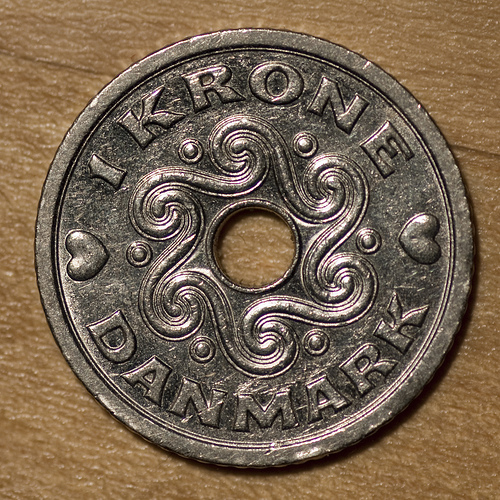
Have you ever seen a 100 Danish Kroner note? If not, here is your chance. We’re running a poetry contest here on In Our Books, and the winner will receive a 100 Kroner note, as well as having their poem and a short interview featured in a future In Our Books post.
Write a poem in any form, of no more than one page in length. The prompt: Write about money – is money a token of love? Or is it just the opposite? Or something altogether different. You tell us!
Please post your answer in the comments for this post* by Wednesday, September 12th, 2012, 11:59 p.m. Pacific Daylight Savings Time [that’s only three days from now!]
We will post the winning poem and a short interview with the poet in a future post!
Thanks for joining in!
*if you prefer to enter non-publicly please use the contact form available by clicking the “contact us” link at the top of this page. Please note that if yours is the winning poem, the poem will be posted publicly here at In Our Books.
Well, what do you know. Here we are – Andrea and Ina.
There are times when the world comes together in a way that’s not quite miraculous and yet not simple coincidence. This blog is the result of one of those. Andrea and I met through a writer’s group on Facebook. I was fascinated in part because – though I had lived in Denmark when I was four – Andrea was the first person from Denmark I had conversed as an adult. Over time it became clear that we shared many things: we are writers; we are educators; we share ideals, and political interests, and an approach to communicating.
So here we are: this is our blog. If you’d like to know more about us as writers (in a formal way), please visit our About Us page.
We are still charting our way here, so both the look and organization of the blog may change over time. Among other things, we’ll be opening discussions on the writing process, sharing our writing lives, and providing many book reviews and interviews with authors, publishers, and other people who love words. Most of all, we want to hear from you – we love comments, and if you have an idea for a topic you’d like to discuss or see discussed, an author you’d love to see interviewed, a book that we must read, please share it with us!
Please watch for our Monday Coffees (something nice to wake up to!) and Connections (our Wednesday interviews and reviews). Our first interview will be with Regina Swint who’s a writer but who also serves in the U.S. Army; how do you sit out there in Afghanistan in the midst of war and keep up your writing?