The Brighter Light, A Kid-Adult Poeming Month, January 2013

The days feel short in Denmark during winter. In the morning it’s dark outside and when you come home, it’s dark too.

Luckily, December is fun. So much happens and most of us feel we meet merry challenges every day but when the holiday presents are exchanged, we need to face January.

ChildAdultSunThat’s why I wanted a bit of fun to happen and hopefully you’ll want to come along. We’re out here to explore the world together and let our children get near our computers, our keys, and share some good times.

Now, just read the rules and follow Ina’s example when she and her son join in.

How to enter The Brighter Light:

  1. You must have an agreement with a child to write 16 poems for January 2013. You, being the poet, and this other someone, a kid (aged 18 or younger), must in a joint effort create the poems according to the prompts that I will provide on the blog during January. I assume the adult will listen to the child and create a poem according to this conversation, but the child might write the poem and listen to you. Either say is fine as long as teammates agree.
  2. You need to create a team name – “The Rocking Tigers” or something like that.
  3. When you come up with a name for your team, please submit it to us along with a short description about yourselves in the comment field for this blog post. Please let us know by December 28th 2012 so we can get your team’s page ready for you!
  4. In your comment, please also include a link to a web-site describing either your surroundings, your nation, or your area; make sure there are some inspiring pictures there which can form inspiring conversations.
  5. When your team name appears on our notice board, you will then have your own team page and you’re ready to go.

The Poeming Month

  1. The initial team entry in the comments below and your team’s poems must be in English.
  2. You can only post one poem per prompt. On your team page on the Notice Board, you can edit and delete so you’re sure that you have entered the poem you want to be there.
  3. The lengths of your poems should be one poem per single-spaced page.
  4. The prompts will relate to the teams’ links to places. If there’re not enough submissions, I will create the prompts and add a link. Hopefully we’ll cover a lot of places around the Earth.
  5. There will be 4 prompts a week. Each team can write 16 poems altogether.
  6. Inourbooks.com will be ready with awards in February 2013. There’ll be an award for the best poem and one for the best collection of 16 poems.

Benjamin West - The Artist and His Son Raphael - Google Art ProjectQuestions and answers:

Q: Can grandparents form teams with their grandchildren?

A: Yes, they can. Uncle and  nephew, mentor and student, any adult and child pair who would enjoy working together, please join us.

Q: Does one of the team members need to be a poet?

A: No, you just write the best poems you can.

Q: Do we need to write all the 16 poems?

A: No, you don’t, but see the rules above.

We look forward to your joining us!

[one extra FAQ from ina] Your child team member doesn’t have to write poetry, or even write at all! You can make this a full-on collaboration, you can follow your baby around and listen to them name objects and use their words as their prompt, you can do what I used to do and pick out their choicest sentences and make found poetry from them – it’s up to you! Many of us have kids in our lives who will be active collaborators, but a wide variety of options is available to your team – just choose how your team would like to work, or vary it from day to day!

Connecting Over Monday Coffee: “The Next Big Thing”

Wilhelm Schreuer Kaffeekränzchen In our previous post, we mentioned that we were invited to participate in a blog chain called My Next Big Thing.  This blog chain isn’t a chain letter but a chance for writers to connect with with one another over the blogosphere – and isn’t connecting what writing is all about? I want to say “thank you” again to our lovely friend Dr. Pearl Ketover Prilik for this chance to share what one of us is up to these days. Please check out Pearl’s Next Big Thing at this link. And after you’ve read Andrea’s description of this *amazing* project she’s working on, please stop in and say hello to the talented people with whom we’re next sharing this chain! – Ina

The Camino near Burgos

The Camino, near Burgos

Andrea’s Next Big Thing

What is the working title of your book or project?

AH: The Tartan Pillow Lead

What sparked the project/book/work off?

AH:I walked the Camino in Spain in 2006 – and why did I? I needed to explain to myself why I did it but after I did it, I most of all wanted to preserve a beautiful picture of the wonderful people I met on the road, The Camino.

The Camino! The Way! People from all over the world walk the Camino every year, and we are following a trail of hundreds of kilometers up north in Spain. There are around 25 kilometers in between the towns and the beds where you can sleep, so for many people the options make it possible. A lot of men wrote about their external sufferings and inner revelations walking these hundreds of kilometers, and I don’t understand this because the majority of people I met on the Camino back in 2006 were women. Women from all over the world losing weight.

I never intended to walk the Camino, but a friend of mine wanted to go there. She had breast cancer, and in a hospital bed without breasts, she cried, “Now I can never walk the Camino.”

And I said, “Of course you can.”

And she said, “Will you bring me?”

And I said, “I’ll carry you all the way if necessary.”

My friend recovered, and every now and then she reminded me of my promise, so one day we were there. “Hello 500 kilometers ahead of you,” I thought one day in Burgos in Spain. It turned out to be a painful nightmare for the first couple of days because I did not know anything else than walking these 500 kilometers (approximately 300 miles) to reach the airport in Santiago to get safely home to Denmark. How would I ever succeed?

I got lost from my Danish friend after two days. Only I met a lot of other people. People from all over the world. People from Holland, Germany, England, Ireland, Canada, America, Australia and yes, all over the world.

I walked all those hundreds of kilometers mostly with three Australians, but I met my Danish friend after 19 days in Santiago. When sitting in a restaurant with my Australian friends, whom I walked with for what felt like a lifetime, my Danish friend asked me, “Andrea, why do you speak in English?”

And what did I say? Likely that it was important for me that everybody around the table understood what I said – only the fact was that I felt more or less Australian. I become “a mate.”

When I returned to Denmark, I started writing about all the experiences with all those hundreds of people that I’d met. I wrote in English, and after three months I ended up with a book manuscript of 72,000 words, now wondering:

Who doesn’t need to follow a long-haired, American anorexic pilgrim walking out there with her plastic bags?

“Being a Franciscan believer doesn’t allow me to own anything,” she said. Only I for one would have loved to buy a rucksack for her. Listening to her endless packing and unpacking of her noisy Spanish plastic bags at 5 o’clock in the morning was hell.

“Sorry, but I need to arrange all my stuff right,” she said.

Or the polite British pilgrim who wore his trekking trousers inside out, explaining to me that the trousers belonged to his dead friend who had wanted to walk the Camino.  He promised this dead friend’s wife that he would wear these trousers along the entire journey, and there he was, “saving” these trousers for Santiago where he would put them on right.

“What an odd promise,” I said.

“Yes, you might say so,” he said, “but that’s how she wanted it, and I do it because she promised me his old car when I return to England.”

How would you describe your project/book/piece of work?

AH: I guess my problem is that I don’t know how to describe it. When you just write like a mad for 3 months and then polish, polish and polish – then you end up wondering what you wrote.

Only basically the genre is non-fiction. I describe poignant incidents but most of all I hope that I meet my fellow pilgrim, Susan, who said: “On my first Camino, I cried – on my second Camino, I laughed.” And I met Susan on her second Camino, luckily, and it should be impossible to be mistaken about cathedrals, towns, roads – but we went lost all the time – in fact we found a cathedral which turned out to be a flamingo dance hall.

And why did we get lost all the time? Because we were two middle aged women who had long lives behind us and needed to tell each other all about them so we missed towns, cathedrals and the arrows on the road because we were so engaged in our conversation. We didn’t see a thing until it was kind of dark or the road, the trail, suddenly stopped.

Only wherever we went, we always were rescued. We, I, were part of a team and we followed Susan who had a tartan pillow so when we saw that pillow in the hostels, we knew that we found the right place, so we booked and stayed there together.

How long did it take you to find your own style and voice?

AH: I love a short and fresh style and I love when I can break it when I need something poignant to be added. And how did I find it? I guess it’s just me like I’m born with this style of mine.

In what ways do you think ‘writer you’ differs from or has similarities to the everyday you?

AH: These are two different characters, sort of. Being a writer, I’m a lot of things but most of all, I’m sharp. In my everyday life, I’m not. Once I wanted to be but life taught me that I’m just a very ordinary kind of quiet person but when I’m writing, well, I’m normally nice but I can be horrible. You see when writing, I am completely honest.

 Who or What makes you pick up that pen or start typing at the keyboard?

AH: I guess that you, the reader, make me want to write. When I was twelve I wrote an ongoing story for a school magazine and when my fellow students protested when the editor wanted me to stop my ongoing story, I felt fine.

I don’t know, really. I’m not much of a speaker, so I guess that writing is a way for me to express myself and when I created something, I always feel fine.

Imagine someone waved a magic wand and you were only able to write one book in your lifetime and you knew it would be perfect and say exactly what you intended and be understood and appreciated by everyone; what would you write about?

AH: I always wanted to create the perfect love story. I’d say “The Tartan Pillow Lead” is a kind of love story so maybe I already wrote it.

So yes, a love story.
Photograph of Coffee Break at National Archives and Records Service (NARS) Conference in the Late 1970s

And  with that perfect ending, here are InOurBooks’ pings for the My Next Big Thing blogger chain:

  • Regina Swint, author of The Other Side of 30
  • Amy Harke-Moore author of poetry, short stories, and non-fiction and editor at The Write Helper [click her link for more info]
Wednesday Connections of a Different Kind

People are so kind.

Every once in a while – usually when I’m driving on Black Friday – I forget that and get very grumpy with all of Homo sapiens. I think about running off to some jungle and eating fruit with the apes. Then I remember that I don’t like mosquitoes, I can’t eat fruit, and my insulin pump depends on my occasionally being near civilization. So I sit and sulk.

Until someone reminds me that, yeah, as a group H. sapiens is pretty amazing, and I should try to live up to my species.

sisterhood-of-the-world-bloggers-award11One heaping cupful of kindness comes from the lovely Dr. Pearl Ketover Pritik, who has nominated me for a blogging award (the  Sisterhood of the World Blogger’s Award) and added us to a blogging chain called “The Next Big Thing.” Thank you, Pearl, for nominating me and check out her answers for the Next Big Thing! Big hug!

But wait! There’s more: Andrea has been awarded a Leibster award – from lovely Sara McNulty, she of the purple pen of Portland.

Because this blog is a joint effort, I am going to answer the questions for The Sisterhood award and Andrea post her answers for the Next Big Thing chain and announce the Leibster.

The Sisterhood award wants me to tell you 7 totally random things about me. So this is about as random as it gets:

  1. My brother and I are not twins, but we have identical birthmarks on our necks
  2. There are three states I haven’t lived in: Montana, Hawaii, and Alaska
  3. I have reverse SAD. I’m a completely different person when it’s foggy or raining – perky, cheerful, giggly.
  4. I don’t have a bucket list. I have an anti-bucket list : things that I will never get to do before I kick the bucket (e.g. have an affair with Heath Ledger/Louis Armstrong /Gene Kelly – I’m married and he’s dead).
  5. I was named after a friend of my mother’s who disappeared shortly after I was born
  6. I find plants and fungi eerie- and the more I learn about them, the weirder I find them.
  7. I modeled for some national magazines. In one of them, I’m wearing electrodes on my scalp.

And now, 7 nominations for bloggers for the Sisterhood:

There were a number of other people I would have loved to have named but some of you are guys (sorry guys!) and many of you have been nominated by others…please know that we were thinking of you!

Monday Twinings Tea

Sitting somewhere and enjoying a proper cup of tea? Coffee? Well, whatever you have and wherever you are, we’re here, and just now, I’m here, Andrea speaking.

William paxton2
No New York here, no cafés, no places to hang out, no corner for me to sit building up audiences of casual guests looking at me and thinking that I am something special. But oh, I’d love it – sitting somewhere being special – I could drink lots of coffees, I’m sure, but as it is, I like to admit that I also drink tea.

I sit in my kitchen, looking straight into my microwave oven, that is if I look up, and cafés: there is the grocer’s which is DagliBrugsen where I live. And just now, it’s tea and you out there. How I love to be connected.

So here I sit in my quiet kitchen and see Ina got something published somewhere. My fellow blogger or to be honest, the head blogger here, made it through!

Poem at Right Hand Pointing

Ina writes about breast cancer and this wonderful medical development that makes it so true to use a metaphor with koi and a frog.

But I sit a little quiet, thinking about my friend, Neser, who didn’t make it. And thinking about Neser, I always end up laughing, though now it is so many years ago. I also know that she likely would have loved Ina’s poem.

I put in another lump of sugar in my tea. It’s cold outside – please see Sidse’s picture from today:

SidsesColdWorld

I feel so lucky that the internet is working today which means Amanda down in Brisbane can announce her recipes for me and for the citizens of Sejer Island.

Amanda, we’re ready. We can’t wait for the lamingtons because they look so good on the pictures. I hope I can squeeze in some more details here though I know that these details might not be in our books – only this blog kind of taught me that maybe they should.

But what is our blog post for today?

Ina and I are running a blog about writing. And we want to introduce a poetry challenge for you:

An Adult-Kid poeming month in January 2013.

  1. You must have an agreement with someone on writing 16 poems for January 2013. You, being the poet, and this other someone, a kid, must create a poem according to the prompts that Ina and I will put here on the blog during January.
  2. You must enter a name – “the rocking tigers” or something like it. You must come up with a name for your team and you must submit this to us along with a short description of who you are.
  3. And I’m sorry but the poems must be in English.
  4. Ina and I will be ready with awards.

Tea tins in kitchen, mostly TwiningsThe prompts will be about describing the world. So we’ll just say, for instance, “England.” Then you will have to come up with a poem about England and then we might say “Bulgaria” and so on.

So here with my Monday tea, I hope I have inspired you all to set off
for yet another challenge.

Please tell us what you think.

Wednesday thought: veils, tattoos, and anvils

In wandering through Duotrope for new venues to send poems, I’ve noticed a number of “serious” journals that will not read or publish “erotic poetry.” Sometimes, it sounds like the sort of aversion that might lead someone to say it with anvils: Just. Don’t. Do. It

But then, I ran across this amazing poem by Richard Fenwick, which originally appeared in the Linden Avenue Lit. Journal. Now, if this isn’t erotic I don’t know what it is: the whole way of hinting at skin, and undressing, while simultaneously denying that undressing (and even skin) is going to be part of the long term picture – I mean isn’t that push-and-pull, that as-of-yet-unfulfilled possibility of fulfillment, the definition of “erotic?”

So now I’m wondering if they mean something else by erotic – Brooklyn Museum - Wallpaper Sample Book 1 - William Morris and Company - page110maybe “explicit?” Or “involving too many semi-medical or gutter-worthy terms for human body parts?” Are  they thinking specifically of the genre of fiction called “erotica”?

I think (for what it’s worth) that if that’s what they’re worried about they should say so, because some of the most beautiful poems in the world are the most deeply erotic. A few examples of my favorites? I’m so glad you asked:

As far as me, on the rare occasions in which I touch on “erotic” themes, they’re usually something like Richard’s (though not even close to the quality in terms of sheer amazing language use) – things hinted at, much left concealed. So tell me: What poems do you find erotic? When you write about love, how do you do it without “expliciticity” or vulgarity? If you’ve never written an erotic poem, give it a thought – how would you approach it? Would you sidle up to the topic? would you hint? Would you be bold?

Monday coffee: This lovely weekend

To cut branch of coffee treeI spent Thanksgiving with my spouse, child and my inlaws. Today we went to see a production of “The Nutcracker” – which has become a family tradition. The Fresno production is lovely – the children are always ridiculously cute; the Sacramento Valley Ballet (the performance  is a joint production between a local ballet studio and the Ballet Co) is wonderful, and the dancers work really well with their young counterparts. The sets are also beautiful – the whole thing, down to the way that Dr. Drosselmeyer’s silly magic tricks conceal his true magical abilities) comes alive on stage.

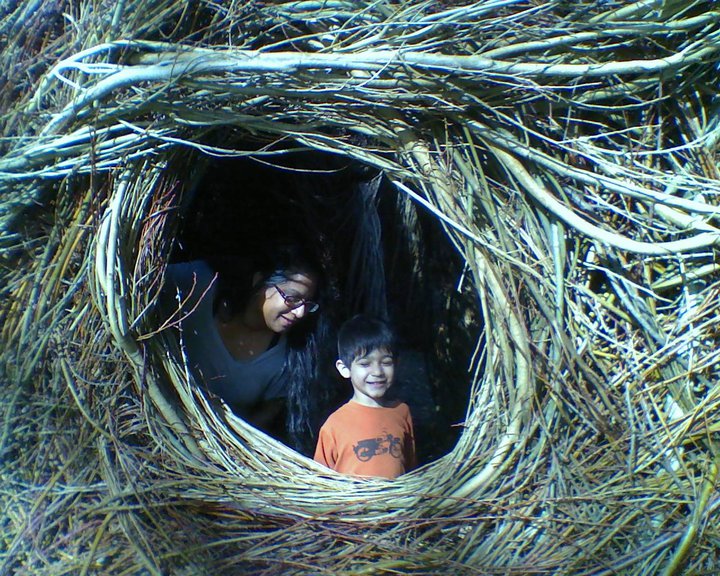
Child and I visiting The Woozle House

On the way home from the theater, we stopped to check out the ongoing development of a Patrick Dougherty installation, called “Learning Curve.” We have a Doughtery installation more local to us as well. My son calls it “The Woozle House” – which has always struck me as just right.

Patrick Doherty sculpture, in process, at CSUFresno

These sculptures: you can be in them, around them, look into them, look through them, and they smell like fresh wood. The one near us sometimes has squirrels playing in it, and there’s almost always kids playing around it – weaving in and out and through it – during the day time. They’re sustainable and they give back to the earth. They make people, even sensible grown people, want to play. But what I love best about Dougherty’s  work is that sometimes the support posts – cut willow put directly into the ground, start to take root.  They literally root and grow leaves and sometimes have other plants use them to grow. The one near our house is now about half green. The art actually comes alive.

Something to strive for, I think.

Monday coffee: in which I give thanks and introduce cows

Artists at All City Coffee 25

In the U.S. the holiday of Thanksgiving is approaching. It’s a kind of odd holiday: people’s kids are in school plays where they dress in Pilgrim gear and worry about starvation, and later that week we have a huge dinner at which we usually overeat. Sometimes we do this while watching sports games on the largest screen we can find. And the very next day, we start a frenzy of Christmas or Chanukah shopping (in my case, both. So glad Diwali is already past!) that looks like sharks converging on an unfortunate school of gift wrapped fish – so scary that it’s even called Black Friday.

And yet, Thanksgiving simultaneous manages to have meaning to almost everyone here, even hard boiled cynics, that goes beyond the physical. It’s almost like the indulgence in the very material parts of our being (buying, eating) gives our hearts some unimpeded time to move towards others, their concerns, their needs, their lives.

Art tends that way too this time of year; the rain starts here in California, and the call from the artist world is expressive, connective. I love the idea of collaborative individuality in Laura Hegfield’s Gratitude Quilt. For a really, um, unusual physical piece of  gratitude artwork, one of my favorite art shows is featuring, this year, a Gratitude Cow (really!)* And for sheer gut-wrenching honesty, painter and poet Stuart Sheldon’s blog post, “Thank,” still  does it for me as it does every year since he wrote it.

I don’t tend to express gratitude publicly, including through writing. I’m too worried about people starving, and difficult court cases, and the Middle East situation, and my friends’ healthcare concerns, &c. You can imagine the sort of thing. But I am grateful for a lot of things, and when I was talking them over with my six-year-old, I was surprised to find that my typical top-10 list (my family, my lovely friends, my eyesight, etc) came up with an addition: this blog. It’s a pleasure taking part in its writing but even more of a pleasure connecting with my blogging partner and with the people who read and comment on and about this blog.

So, thank you, friends, for making this blogging thing such a joy.

*If you’ve never run across the Cow Parade, well, you’re in for a treat!CowParade Prague 2004 023 ALCHEMICOW

Connections: We want to publicize your triumphs!

Andrea and I want to hear about your latest creative kudos, and we’ve got a place for you to tell us and the rest of the inourbooks community about them! Our Notice Board is a place for you to post links to newly published material, your new blog or website, new reviews of your latest book or gallery showing – you name it, we want to hear about it!

All you need to do is click the “In Our Notice Board” link in the black band under the F.A. Cup Trophylighthouse to be transported to the notice board. Simply register to share your joys and triumphs with us all!

In addition, our notice board has threads devoted to various web-based creative activities (currently, there’s a thread on NOVPad in case you’re frustrated with trying to post on Poetic Asides) and calls for submissions (if you’re running a contest, reach some terrific artists through our board), so make sure to stop by and check them out 🙂

Looking forward to many exciting future conversations!

Ina

Monday coffee: A month of living dangerously

For many creative writers who have writing lives on the internet, November is a month in which one walks softly and carries a big coffee cup. Why? Because November is when all the challenges Douwe Egberts koffie kopcome out of hiding, and it’s so hard for a writer to resist. To name just a few:

And these are just a few of these events.

Each of these events has detractors. And they are often right to point out problems. Some argue that really good writing needs to happen in its own time and under its own steam. Others believe that the process of creation is more important than the goal (whether that goal is a number of poems written or the number words on a page), but that some of these events focus on goals and discourage mindfulness. Some people need to move on – to pass up the “game” feeling and do the serious, ugly work of revising. Still others have tried one of these events and found the month to be frustrating if one has more than one outside responsibility.

So why do any of these things? Last year,  I did two of these events simultaneously.One of them was the November chapbook challenge. But the other? That was Nano.

I’ve always said I could never write a novel – I’m a short form gal – and I decided to put my money where my mouth isn’t. I decided to prove myself right by trying to write a novel while taking care of my kid (who has some special needs involving lots of doctors and therapists) and holding down a full time job. And I felt GREAT. I was sleep deprived, and overworked; I got carpal tunnel, and the resulting novel was and is truly lousy. And I still would not trade that month for anything.

What I learned was that, really, when all is said and done, I may not be a novelist, but I love writing. I love the words, I love the turn of phrase, I love the transfer of images from my head onto the page. That recognition – the recognition of one’s self as a writer? That’s priceless.

So will you share with us? You know you’re an artist (a writer, a painter, a sculptor, a director…) or you wouldn’t be here at this blog. Are you participating in any or all of these writing events? What does participating, or not participating, tell you about your own creative heart?

Friday surprise: Advice From a Good Midwestern Girl

If you take a gander at the picture of me on the “About Us” page, the first thing that does not come to mind is “Ah, a Good Midwestern Girl.” If you know me personally, the idea of me as a GMG probably makes you giggle uncontrollably. But  I am, at heart, a nice Nebraskan woman.   I cannot pass up a really good steak. My spell check is configured to automatically replace “towards” with “toward,” because I’ve given up on the idea that I’m ever going to type “toward” of my own volition. And I always make my own Thanksgiving stuffing – from scratch, thank you.

Which is why I was stunned by what I read in this interesting and in-depth article about what editors of lit magazines want (on The Review Review).

Lynne Barrett’s article is full of good advice for people hoping to find recognition and publication in literary journals.  She mentions practical stuff like keeping good records of where you’ve sent work out and making sure you indicate when submissions are simultaneous. But most of this (rather substantial) article’s advice amounted to this:

BE POLITE.

That’s it: be polite. It’s really sad that grown up artists – writers, painters, actors – have to be told to use the same rules that govern polite society when they approach someone about displaying/publishing/supporting their work.

The Reception

Being polite is in the interest of both the artist and the purveyor of artistic work.  In the same way that it’s not just nice but practical to give your mechanic a  plate of homemade cookies for New Years, it’s not just rude but stupid to send a nasty-gram to an editor who rejects a favorite story. That same editor might have loved your second-favorite story, but not if you’ve gone off the rails at her once. And an editor who will identify you to other editors as One Big Headache will not help you create a professional reputation.

 Let’s look at a less obvious example. Most editors have a clear and transparent submission policy; the results of that policy are usually apparent in the publication itself. So it’s easy to find out if the journal in question does not publish genre fiction, or is primarily interested in travel writing, or only publishes poetry in the style of Mary Oliver. If you send in a submission, without checking the publication’s style or requirements, you are essentially indicating that what the editor/manager/publisher of the magazine wants is not important to you. Is that really the message that’s going to get your work accepted?

An analogy: I had an attractive friend who tried on-line dating. In her profile, she stated explicitly that she would not date men who didn’t share the basic tenets of her faith. She wasn’t looking for a high income level, movie star looks, anything like that. Just a decent person around her age who shared some of her basic life views. The number of dates she went on where the person eventually mentioned that they totally disagreed with her faith was astounding – we stopped counting. And what was worse: most of the people told her they’d looked at her picture and contacted her because she was “cute” ; they told her that they didn’t care what she’d written.

Good Manners

That’s not very polite, is it? And it’s equally impolite to send an editor whatever we feel like without stopping to find out if it’s something they’d spend their time reading. If we expect respectful treatment for our work, we need to treat those who might support it respectfully as well. I’m saddened by how often  fellow artists haven’t looked at the art work carried by a gallery they’d like to show their work in or haven’t read a sample issue of the publicatin in which they hope their work will appear.

This may seem unfair; after all, buying sample magazines is expensive and tickets to indie film festivals add up. But there are work-arounds. Many publications provide PDFs of  previously published stories; lots of indie film festivals archive of clips of prior years’ winners online. More importantly, not being polite also costs you: time unpublished, time dealing with boomeranging artworks that could be used as creative time,  time, energy and money for resubmissions.

Almost all Barrett’s advice  – from how to respond to an acceptance letter to what to do about simultaneous submissions – comes down to being a courteous person. Don’t do to an editor/gallery manager /producer-director what you wouldn’t want someone to do to you. It’s really that simple.